


Air Pollution: The Story of "Apples and Oranges"

Original article (in Vietnamese): https://dantri.com.vn/tam-diem/o-nhiem-khong-khi-chuyen-qua-tao-va-qua-cam-20250123083355941.htm
Air Pollution: The Story of "Apples and Oranges"
Recently, air pollution has become a hot topic for Hanoi and Ho Chi Minh City. The press has repeatedly reported that Hanoi is among the most polluted cities in the world, with the Air Quality Index (AQI) in Hanoi ranging from over 200 to over 300.
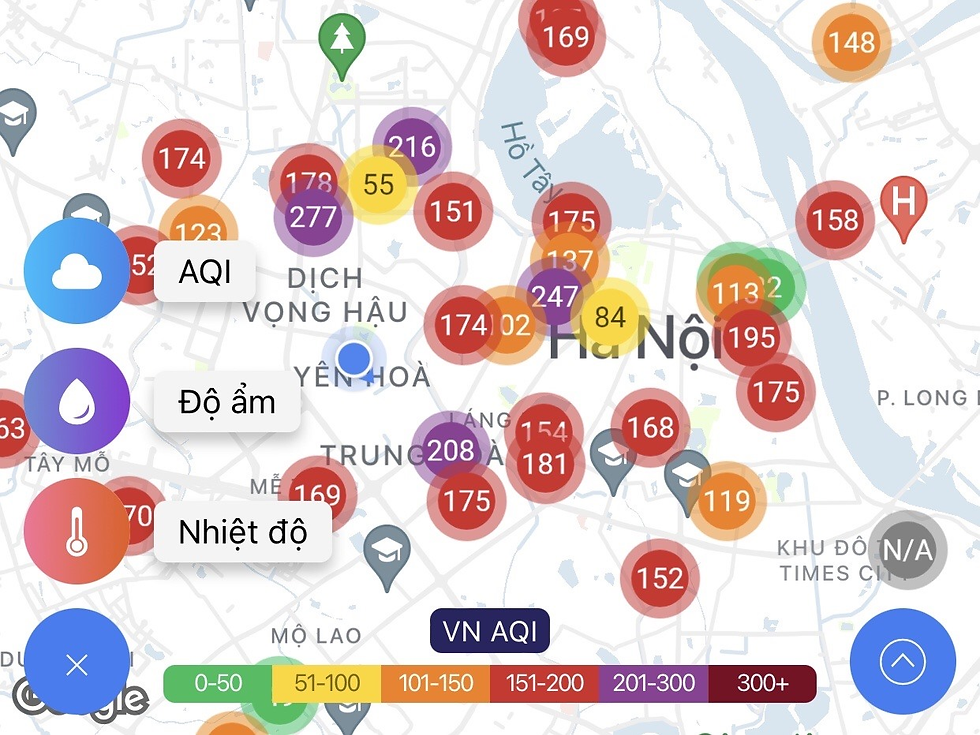
The AQI ranges from 0-500, meaning the higher the index, the more severe the pollution level, and the greater the impact on humans. Everywhere in the world, air pollution is a "silent killer," which can increase the risk of stroke, heart disease, lung cancer, and respiratory diseases such as asthma. Typically, lower-income and vulnerable groups such as children and the elderly suffer these impacts the most.
The story of air pollution in Hanoi and Ho Chi Minh City is real; often we can feel it ourselves when looking at long lines of traffic jams and the hazy sky. However, the approach of "naming and shaming" this city or that city as the most polluted in the world can be misleading and, above all, not entirely scientifically accurate.
Pollutants—the main cause of poor air quality indices—are often not similar or differ significantly between cities. There is a famous idiom in English: "Apples and Oranges," referring to two things that have similarities but cannot be compared with each other. Claiming that this city is more polluted than that city is no different from comparing apples and oranges.
Besides familiar indicators measuring pollution such as fine dust particles PM10 and PM2.5, AQI is mainly based on other common pollutants such as carbon monoxide (CO), nitrogen dioxide (NO2), sulfur dioxide (SO2), and ozone (O3). But there are still many other pollutants such as VOCs (volatile organic compounds), ammonia... that are not included in the AQI calculation. This makes the AQI not accurately reflect the comprehensive pollution situation.
In addition, factors such as wind, humidity, temperature, and atmospheric stability greatly affect the level of air pollution and the dispersion of pollutants. On windless days or under unfavorable meteorological conditions, pollution can accumulate in an area, but the AQI does not reflect this immediately. Conversely, in strong wind or rain conditions, pollution can be "washed away" or dispersed, reducing the AQI, even though the actual pollution level may still be high.
Each country may have different ways of calculating AQI and standard thresholds based on factors such as important pollutants in each region, public health studies, and the population's sensitivity to air pollution.
Furthermore, some cities will not make the "most polluted" list simply because they do not monitor air quality, like many cities in Africa. Even cities that monitor pollution levels will have different numbers of monitoring stations in each location.
Monitoring stations might be concentrated in less polluted residential areas in an "apple," but placed on busy roads with high pollution levels in an "orange." To have convincing universal data, a minimum number of monitoring stations needs to be ensured, yet this is often not mentioned in pollution city rankings on popular apps.
I am living in Japan, which is evaluated by most rankings and apps as one of the less polluted countries in the world. According to IQAir's report, Japan's average AQI was 40 in 2023. So is Japan's air quality really not harmful to human health? In reality, the fine dust PM2.5 pollution index in Japan is still more than twice the recommendation of the World Health Organization. In 2019, there were more than 42,000 deaths related to air pollution in Japan, according to a report by Statista.
There are many reasons why using AQI ranking tables is easily misleading. First of all, air pollution is a complex issue and cannot be solved through simple judgments or ranking lists.
In Vietnam, efforts to improve air quality are being implemented through developing public transport, encouraging the use of environmentally friendly vehicles, and limiting polluting activities. We need to look straight at the air pollution problem, but we need a scientific and selective approach to avoid biased assessments of efforts and actual results, when difficulties such as unsynchronized infrastructure, high levels of industrialization, or large numbers of personal vehicles remain major challenges.
"Naming and shaming" a certain city for air pollution can help the issue get more attention, thereby forcing authorities and people to take necessary measures. But reality in the world also shows that excessive "naming and shaming" can lead to extreme reactions, such as "giving up" or hiding data to avoid criticism for authorities, and creating a negative mentality for the people.
Solving the air pollution problem requires a long-term vision. In Japan, the government and people always value environmental protection, especially minimizing air pollution through many effective measures. The Japanese respect a lifestyle in the spirit of "Mottainai," encouraging resource saving, reusing items, and minimizing plastic waste by using reusable bags when shopping. Besides, they prioritize using modern public transport such as subways, Shinkansen, and buses, while widely applying environmentally friendly vehicles like hybrid cars (combining two energy sources: gasoline and electricity).
Community awareness among the Japanese is raised through environmental education from a young age, combined with cleaning activities in schools, neighborhoods, and protecting public areas. A culture of living in harmony with nature and the tradition of honoring the beauty of nature through major festivals like Sakura (cherry blossom) or Momiji (red leaves) has helped people become more attached and conscious in protecting the fresh atmosphere.
Major cities in Vietnam like Hanoi and Ho Chi Minh City can learn from countries that have succeeded like Japan in improving air quality, and at the same time, share their own initiatives with other countries.
Clean air is a basic human right, and we need urgent action to reduce air pollution—especially in rapidly developing countries like Vietnam. Ranking and pointing out the most polluted cities, as analyzed above, may not be entirely scientifically accurate, and therefore may be used for the purpose of directing information rather than a methodical approach.
Instead of just looking at rankings, we need to think carefully and focus on long-term, scientific solutions and international cooperation to build a more sustainable future.
By Pham Tam Long


Comments