


Green Transition: The Era of Flowery Commitments Has Passed

Original article (in Vietnamese): https://dantri.com.vn/tam-diem/chuyen-doi-xanh-da-qua-thoi-cua-nhung-cam-ket-hoa-my-20251215221001200.htm
During these early days of winter in Beppu (Japan)—the city where I currently live, famous for its underground geothermal waters—fog often blankets the mountainsides. Looking from a distance, the plumes of white steam rising from hundreds of hot springs look little different from the smoke billowing from the industrial zones of Oita Prefecture, just 30 kilometers away. But the difference lies in their nature: one is the healing breath of the earth, the other is a burden on the atmosphere.

This similarity in form but difference in essence often reminds me of the story of "green transition" that we are discussing so excitedly in Vietnam. Like that layer of fog, many sustainable development reports seem to be covered in a misty, beautiful veil, yet they lack the clarity needed to see the core inside.
We are living in an era where the set of standards for evaluating corporate sustainability - ESG - has become a keyword. Everywhere you go, you hear about "green" and "sustainable." Once unfamiliar, ESG now appears solemnly in mission statements. Tree-planting campaigns, efforts to reduce plastic waste, and community activities are being rolled out with great fanfare. These are welcome signals, showing that an awareness of social responsibility has begun to take root.
However, if we look deeper and more strictly according to international standards, it seems we are still stopping at the "branches" rather than getting to the "roots." There is an invisible but vast gap between "doing good" (charity, surface-level acts) and "being sustainable" (operating a sustainable business model based on data).
In Japan, the concept of Greenwashing (building an eco-friendly image without corresponding action) is being condemned and controlled more strictly than ever before. The Financial Services Agency of Japan (FSA) has begun tightening related supervisory regulations. Japanese business culture often highlights the philosophy of "Honne - 本音" (true sound/inner feelings) and "Tatemae - 建前" (public facade). If Tatemae is what is shown on the outside—the social etiquette—then Honne is the truth, the real intention inside.
Applying this to the ESG story, many businesses seem to be performing the Tatemae very well—that is, the media shell with beautiful images. But international partners, investment funds, and demanding markets like Europe and the US are looking for the Honne. They are no longer persuaded by flowery commitments. What they need is verification that comes from dry, but honest, numbers.
We can see a quiet but decisive shift: From "green marketing" to "green compliance." This change is driven not by conscience, but by the pressure of cash flow and the law. When Europe erects barriers like CBAM (Carbon Border Adjustment Mechanism) or EUDR (European Union Deforestation Regulation), they don't care how many billions of dong your company has donated to charity. They only care: Can you prove with satellite data that this shipment did not cause deforestation? How much money did you pay for the carbon emitted while producing this shirt?
This is the moment the "green shell" of many businesses is stripped away. The sad reality is that many companies still approach ESG with a mindset of coping or "ticking the box." Achieving an ISO certificate or an environmental award is the final destination for many businesses—something to hang on the meeting room wall. But for international partners, that certificate is merely a parking ticket. To enter the main party, you need a "passport," which is a transparent data system.
The price of truth, at first glance, seems very expensive. Investing in an automated environmental monitoring system, converting to clean technology lines, or hiring independent auditing units to verify emissions reports... all cost money and resources. In a difficult economic context, cutting costs is a top priority, and the budget for ESG is often the first thing to be crossed out or done perfunctorily.
But if we look further, the price of deception or delay is far more expensive. It is the price of being eliminated from the game. Look at Vietnam's textile and footwear industries. When major international brands set Net Zero targets for their entire supply chain by 2050, that pressure immediately weighed on the shoulders of manufacturing factories in Vietnam. At this point, the harsh truth appears: Not being "green" means no orders. Not being transparent means not being able to borrow "green credit" from banks at preferential interest rates.
However, in every challenge, there is opportunity. The purification of the ESG market is also the time for businesses that do real work to shine. I believe Vietnamese businesses need to change their mindset: Stop viewing ESG as a cost burden or a trick to polish your name. View it as an investment in governance infrastructure. Transparency, though sometimes painful because it exposes weaknesses, can be the strongest shield.
Business owners themselves also need the courage to face the truth. When you dare to publish emissions data, even if the numbers aren't beautiful yet, you are sending a signal of honesty and a commitment to improve. International investors, especially funds from Japan or Europe, often value the effort to improve based on real data more than empty promises.
The "greenwashing" that the media often mentions sometimes does not stem from an intent to deceive, but from a lack of understanding or tools. Businesses may unintentionally exaggerate what they do because they lack precise measuring sticks. Therefore, instead of condemning, I think we need a more tolerant and supportive view. We need specific guidance mechanisms from regulatory agencies and more accessible green credit packages so that businesses have the resources to invest in data infrastructure.
In this new flow, those businesses that quietly invest in governance systems, save every drop of reused water, and optimize every transport stage to reduce fuel... will be the silent winners, firmly holding the ticket to the global supply chain.
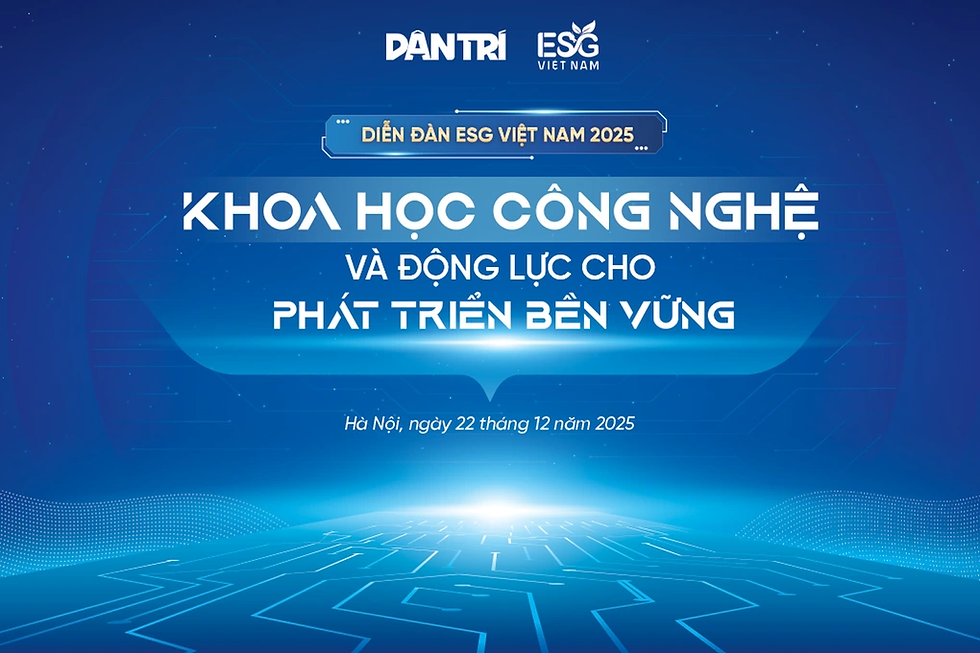
To make this journey from "shell" to "core" less lonely, we need open and realistic dialogue spaces. In the coming days, the Vietnam ESG Forum 2025 will be held, gathering policymakers, experts, and the business community. I hope this will not only be a place to honor achievements but will become a "laboratory" of thinking, where difficulties regarding data, technology, and capital are dissected fairly.
It is at touchpoints like these that experience from those who went before becomes a lesson for those who follow, and where distant international standards are "Vietnamized" to become closer and more feasible. When we sit down together, not to compare who is "more ESG," but to find solutions to survive and develop together, that is when sustainable thinking truly takes root.
All change takes time, and I believe that with an open mind and a hunger to learn, Vietnamese businesses will soon overcome the "shell" stage to touch the depth of sustainable development.
By Pham Tam Long


Comments